In a retail space, background music is just as much a part of the guest experience as the lighting or the furnishings. With a well-designed system, the music plays evenly everywhere, no one has to shout over it, and the service staff doesn't have to fiddle with the volume every day. Below, we have put together what you should consider before deciding on the installation of a sound system.
How many zones are actually needed?
In most places, a single volume level is not the right solution: the dining area, the bar, the terrace, and the restroom corridor require different levels. If the system can be divided into zones, the volume can be adjusted separately in each area, and a different source can be played if necessary. It is worth deciding on this structure at the beginning of the planning stage, because later on it typically becomes a cabling issue.
How many speakers and where?
Several lower-power speakers provide a more even soundstage than a few loud speakers. Ceiling height, surface materials, and furnishing all influence how many points are needed: in a space with bare walls and hard surfaces, multiple quieter speakers are the right solution. In the case of ceiling installation, mechanical routing must also be coordinated in advance.
Where does the music come from?
The source can be a business music service, a personal player, or a streaming device. It is important that the system is easy to use: in daily operation, a good solution is one that the staff can learn in a few minutes and that does not require searching for a separate device. Selecting a legal, business-use music source and settling royalties is the operator's responsibility.
What do I need to prepare for commissioning?
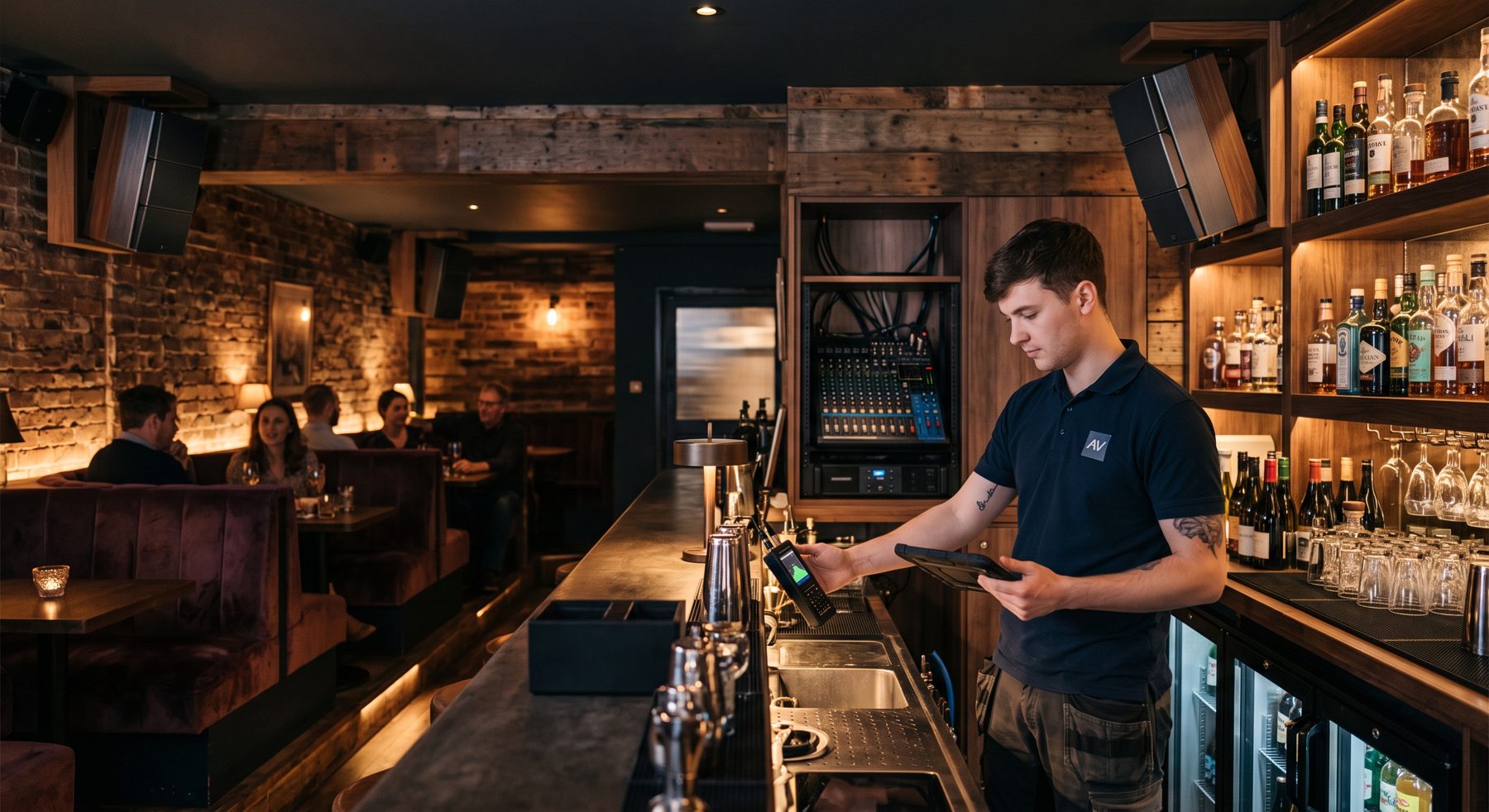
After installation, the system needs to be tuned in the actual space: music sounds different in an empty room than in a full one. It is advisable to set a fixed, limited volume range so that daily operation cannot overdrive the system, and at the end of commissioning, the staff should also be trained in the operating procedures.
Will the system remain expandable?
If a terrace, a private room, or a projector might also be considered later, it is worth taking this into account when choosing the head unit and cabling. A forward-thinking basic system can be expanded more cheaply later than a restrictive one. If you are planning the sound system for a commercial space, write to us, and we will discuss the options.